Sah: Uniting With the Supreme Self
- Jason Baldauf
- Aug 24, 2025
- 3 min read

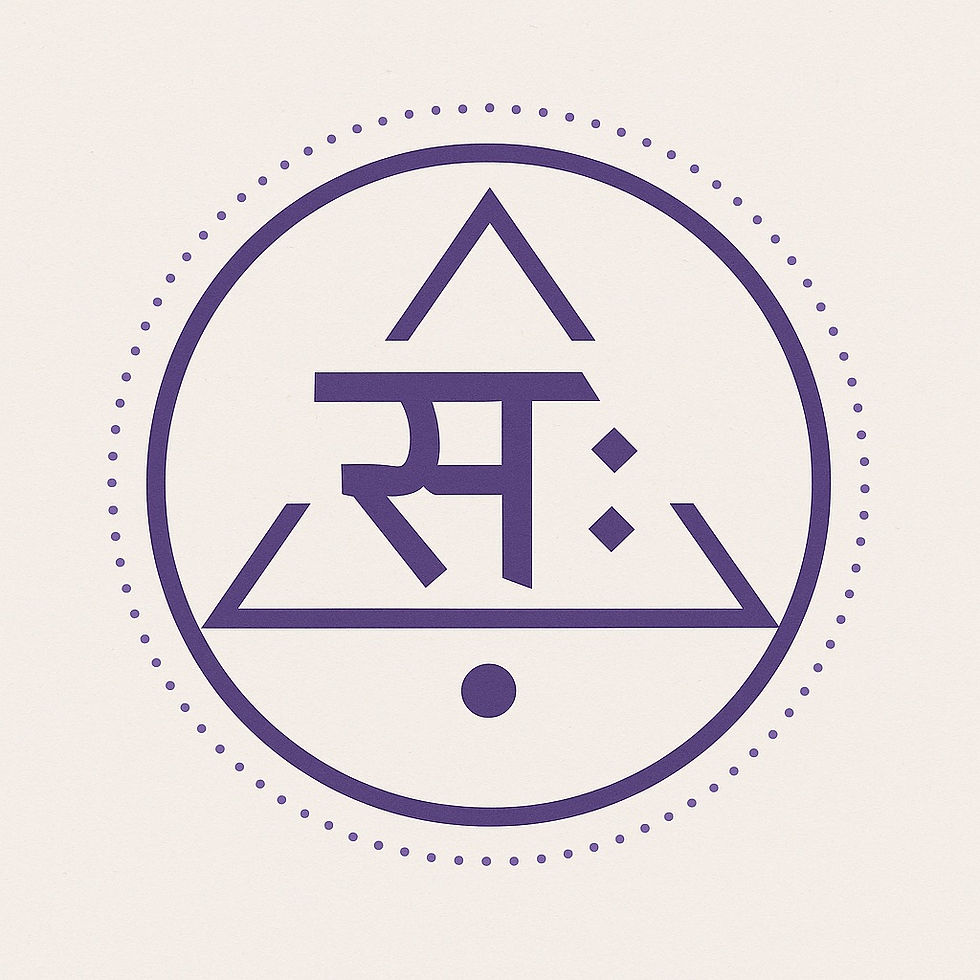
“That which is the subtle essence—in it all that exists has its self. It is the True. It is the Self. And you are that.” - Chandogya Upanishad 6.8.7
In the rich tradition of Vedic and Tantric mantra practice, bija mantras, or “seed sounds”, serve as powerful focal points for meditation, transformation, and spiritual connection. Each bija holds a specific vibrational signature, acting as a sonic key to different aspects of consciousness and universal principles. Among these potent syllables, the mantra Sah (pronounced as Sahh, with a soft release) often appears subtly, yet it carries profound implications. Sah is associated with cosmic unity, divine presence, and the dissolution of individual identity into the Supreme Self.
The bija Sah emerges most prominently in the Gayatri Mantra, where it is found in the phrase:
Tat Savitur Varenyam
Bhargo Devasya Dhīmahi
Dhiyo Yo Nah Prachodayāt
Here, “Tat Savitur” refers to the divine light of the Sun (Savitr), and the syllable Sah is sometimes meditated upon silently as a representation of that universal essence “That is He” or simply “That”, pointing toward the undivided, impersonal absolute. In this sense, Sah functions similarly to Tat, both pointing to Brahman, the ultimate reality.
While not traditionally assigned to a specific chakra like more active bija mantras (e.g., Lam, Yam, Ram), Sah resonates at a transcendental level, often linked with the sahasrara (crown chakra) or even beyond the chakra system altogether. It signifies a dissolution into universal consciousness, aligning with the yogic goal of merging the individual self (jivatman) with the cosmic self (paramatman).
At its core, Sah translates simply as “He”, in the impersonal divine sense, not gendered, but rather denoting the one who is, existence itself, or conscious presence. It is found in the phrase “Soham”, meaning “I am He,” which reverses to Hamsa, another sacred mantra connected to the breath.
Sah is:
A pointer to the Supreme Being
A symbol of divine awareness
A sonic bridge between form and formlessness
A mantra of nonduality, gently reminding the practitioner of their oneness with all that is
It is the sound of silent presence, of being itself: of sat, cit, ananda (truth, consciousness, bliss).
When chanted aloud, Sah produces a soft, open vibration that naturally leads the mind into stillness. It lacks the sharpness of other bija mantras, instead encouraging a spacious and expansive awareness.
Elemental Correspondence: Often associated with space (akasha) or pure consciousness
Color: Subtle indigo, violet, or white, echoing the spacious quality of crown-consciousness
Direction: Often linked to above or the center, representing the axis of spiritual connection
Energetically, Sah helps dissolve boundaries, between self and other, sound and silence, subject and object. It facilitates meditative absorption (samadhi) and surrender.
Because of its subtlety, Sah is often used in mental japa (repetition) or as part of silent breath meditation. It pairs naturally with the inhalation or exhalation in the Soham breath cycle:
Inhale: So
Exhale: Ham
The reversed Ham-Sah becomes Sah on the exhale, emphasizing the dissolution into the divine.
You can also use Sah on its own as a soft chant or focus word in meditation, particularly when seeking to dissolve the ego, quiet the mind, or connect with universal consciousness.
It’s an ideal mantra for those practicing:
Jnana Yoga (the path of wisdom and nonduality)
Raja Yoga (especially in meditative absorption)
Advaita Vedanta contemplation
Surrender practices such as Ishvara Pranidhana
Integrating Sah into Your Sadhana
To integrate Sah into your daily spiritual practice, try the following:
Silent Meditation: Sit in stillness, silently repeating Sah on each breath out. Feel yourself dissolve into the sound.
Chakra Meditation: Visualize violet light above the head (crown chakra) and silently intone Sah to align with universal wisdom.
Japa Mala: Repeat Sah with each bead, allowing each repetition to become more spacious and still.
Pair with Crystals: Meditate with iolite, clear quartz, or amethyst to support spiritual clarity and inner vision.
Sah may be small in sound, but it is vast in significance. It is the seed of surrender, the syllable of the Supreme, and a whispered reminder that our truest identity lies not in separation but in unity. To chant Sah is to step gently into the silence where only presence remains. It is the sound of the Self, the breath of Being.
When the mind quiets, when the striving ceases, what remains is Sah: He, That, the eternal witness in all.


Comments