Through Ancient Eyes: Understanding the Old Testament in Its Historical Context
- Jason Baldauf
- Aug 9, 2025
- 6 min read

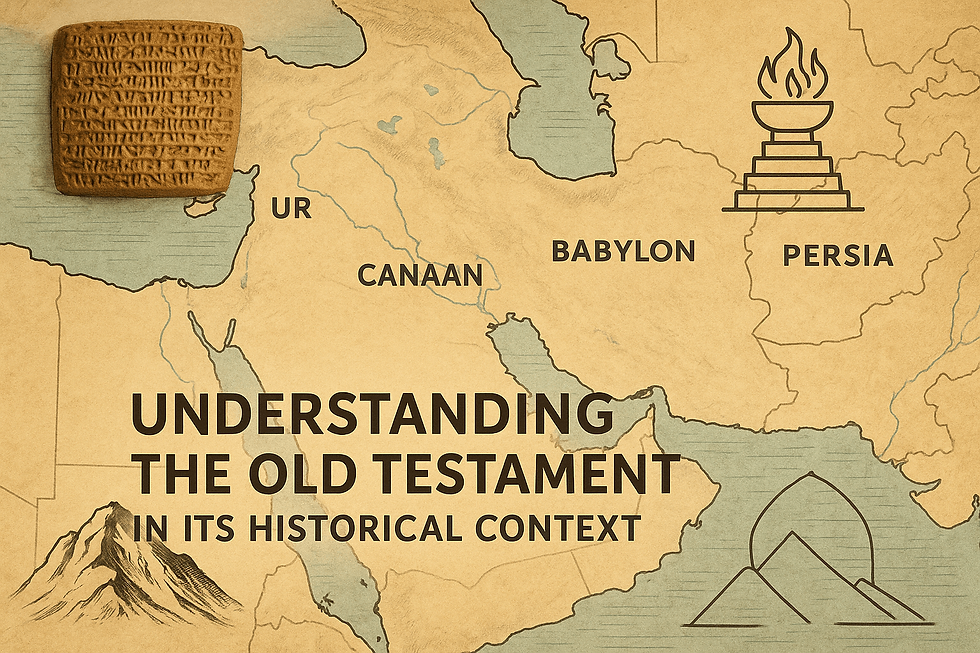
"To read the Bible without understanding its world is to hear only half the conversation." – Adapted from John H. Walton
When most people open the Old Testament, they imagine they’re stepping into a self-contained spiritual world, a record of God’s dealings with Israel alone. But the reality is far more complex and fascinating. The Hebrew Scriptures were written and compiled over centuries, shaped by the empires, cultures, and religious ideas of the ancient Near East.
Knowing this background is like putting on a new pair of glasses, suddenly, familiar passages take on deeper layers of meaning.
The World Behind the Bible
The Old Testament didn’t appear in isolation. The Israelites lived in a neighborhood crowded with powerful civilizations, each with its own gods, myths, and political agendas. To understand the text, we first need to meet the neighbors.
Sumer: The World of Abraham’s Birth
Long before Jerusalem became the center of Israelite faith, the great cities of Sumer dominated southern Mesopotamia. Abraham, the patriarch of Israel, is said to have come from Ur, a thriving Sumerian city-state that worshiped the moon god Nanna (also called Sin). Sumerians gave the world some of its earliest writing, law codes, and literature. In their worldview, humans existed to serve the gods, bringing offerings to keep the divine realm satisfied. This belief system formed part of the cultural air Abraham breathed before his journey toward a new understanding of one God.
Babylon: Empire and Exile
The Babylonians inherited much from Sumer but took it further. They are remembered for Hammurabi’s Code, a legal system that, like the Law of Moses, covers everything from theft to marriage. The famous Epic of Gilgamesh contains a flood story strikingly similar to Noah’s. Centuries later, the Neo-Babylonian Empire conquered Judah, destroyed the Temple in Jerusalem (586 BCE), and took much of the population into exile. This was a turning point: cut off from their land and Temple, the exiles refined their faith into something portable, focusing on Scripture, prayer, and the hope of restoration.
Assyria: The Iron Fist
Before Babylon’s rise, the Assyrians ruled much of the Near East with unmatched military force. Their campaigns and deportations devastated the northern kingdom of Israel, an event that echoes through prophetic books like Nahum and Isaiah. The prophets often warned that foreign domination was not just politics, it was divine judgment.
The Chaldeans: Astrologers and Conquerors
The term Chaldean often refers to a people within southern Mesopotamia famous for their skill in astronomy and astrology. By the time of Nebuchadnezzar II, they were the ruling dynasty of Babylon. Biblical references to “Chaldeans” often carry the weight of both imperial power and mystical knowledge, elements that fascinated and sometimes troubled Israelite writers.

Date (BCE) | Event / Empire | Relevance to the Old Testament |
3000–2000 | Sumerian City-States | Writing, law codes, myths; Abraham’s cultural backdrop. |
1792–1750 | Babylon under Hammurabi | Legal parallels to Mosaic Law. |
1250–1050 | Israel’s Tribal Period | Judges; transition to monarchy. |
900–612 | Assyrian Empire | Conquest of northern Israel; prophetic warnings. |
605–539 | Neo-Babylonian Empire | Destruction of First Temple; Exile. |
539–332 | Persian Empire | Return from exile; Zoroastrian influence. |
332–63 | Hellenistic Period | Greek language, philosophy, and politics shape Judaism. |
63–70 CE | Roman Period | Context for Jesus and the New Testament. |
The Religious Crossroads
The Israelites didn’t develop their religion in a vacuum. They interacted, sometimes peacefully but often in conflict, with the gods and myths of surrounding cultures.
Canaanite Roots
Before the Israelites settled in Canaan, the land was home to a pantheon of gods led by El, alongside Baal, Asherah, and others. Some of these divine names and titles (like El Elyon, “God Most High”) appear in the Old Testament, showing a gradual shift from shared West Semitic traditions toward exclusive worship of Yahweh.
The Moon God Sin
Worshiped in Ur and Harran, Sin was associated with wisdom and the passage of time. Some scholars note that “Sinai”, the mountain where Moses met God, may carry the name of this deity. While the biblical narrative reframes Sinai as the meeting place with Yahweh, the name itself may hint at older associations.
Zoroastrian Influence
When the Persian Empire conquered Babylon, the exiles came under the influence of Zoroastrianism, the faith of the prophet Zoroaster. This religion emphasized a cosmic struggle between good (Ahura Mazda) and evil (Angra Mainyu), the importance of moral choice, and the idea of a final judgment. Beliefs about angels, demons, resurrection, and the ultimate triumph of good became much more prominent in Jewish thought after this period, shaping later works like Daniel and influencing New Testament themes.
Egyptian Connections
Egypt was both a place of refuge and of oppression in Israel’s story. Egyptian religion, with its emphasis on divine order (Ma’at), judgment after death, and the role of sacred kingship, shares intriguing parallels with biblical ideas, though often reinterpreted in a distinctly Hebrew way.
Who Was Yahweh?
Yahweh, the God of Israel, didn’t enter history as a fully formed monotheistic concept.
Possible Origins
Some of the earliest non-biblical references to “Yhw” appear in Egyptian texts mentioning a people called the Shasu, living in the southern deserts of Edom and Midian. The Bible itself hints that Moses first encountered Yahweh in Midianite territory.
From Tribal Deity to Creator of All
In the earliest stages, Israelite religion may have been monolatrous, worshiping Yahweh exclusively without denying the existence of other gods. Over time, especially through the prophetic tradition, Yahweh was proclaimed as the sole creator and ruler of the universe.
The Turning Point of the Exile
The Babylonian Exile was decisive: without a land or Temple, the Israelites clung to their God as the only true deity, rejecting idols entirely. By the time of the return under Persian rule, monotheism was firmly established.
Deities & Their Spheres of Influence
Culture | Deity | Domain | Biblical Relevance |
Sumerian | Nanna / Sin | Moon, time, wisdom | Worshiped in Abraham’s birthplace. |
Babylonian | Marduk | Creation, kingship | Echoes in creation imagery. |
Canaanite | El | Chief god | Some titles transferred to Yahweh. |
Canaanite | Baal | Storm, fertility | Opposed by prophets like Elijah. |
Persian | Ahura Mazda | Supreme good deity | Zoroastrian influence on monotheism. |
Persian | Angra Mainyu | Evil spirit | Influences later ideas of Satan. |
How the Old Testament Reflects This World
Once you know the background, it’s easy to see how the Old Testament is in conversation with its environment:
Creation & Flood: Parallels with Mesopotamian myths, but reimagined with one God whose creation is orderly and good.
Law: Similarities with ancient law codes, yet grounded in covenant relationship with God.
Prophets: Speaking against imperial oppression while calling for justice and faithfulness.
Wisdom Literature: Proverbs and Ecclesiastes share themes with Egyptian and Mesopotamian wisdom texts, yet always framed in devotion to Yahweh.
From the Old Testament to the New
By the time Jesus began his ministry, Jewish thought had been shaped by centuries of interaction with other cultures, and by the trauma of exile and occupation.
Second Temple Judaism
This era (roughly 516 BCE to 70 CE) saw the rise of apocalyptic literature, renewed messianic hopes, and a strong focus on the Law as identity. The influence of Persian, Hellenistic, and even Roman thought created a complex religious landscape.
Jesus’ Place in This Story
Jesus taught within this tradition, drawing on the Law, the Prophets, and the Psalms. His language about the “Kingdom of God,” resurrection, and final judgment reflects both Israel’s heritage and the post-exilic world’s ideas about cosmic justice.
A New Covenant
Early Christianity took Old Testament themes: covenant, salvation, restoration, and applied them universally. Many of the concepts that Christians today take for granted, from angels to eternal life, entered Jewish thought during those centuries of cultural exchange.
Reading the Old Testament with New Eyes
To read the Old Testament with historical awareness:
Compare biblical stories with other ancient texts.
Notice where Israel’s writers adapt or reject surrounding beliefs.
Pay attention to historical events like the Exile, they are turning points in theology.
Remember: the Bible’s authors were not writing in a vacuum, but in conversation with their world.
The Old Testament is the product of a centuries-long dialogue between God’s people and the world around them. Understanding Sumerian myths, Babylonian laws, Canaanite religion, and Persian dualism doesn’t diminish the Bible, it enriches it.
And when we see Jesus through this lens, we find that his teaching was both rooted in the deep soil of Israel’s past and open to the winds of new ideas that had blown through for centuries.
Below is a link to a GPT to assist in gaining insight into Old and New Testament context, or perhaps as a study alongside of a bible study:


Comments