Sacred Geometry: Blueprint of Creation
- Jason Baldauf
- Feb 8, 2025
- 4 min read

Updated: Oct 6, 2025
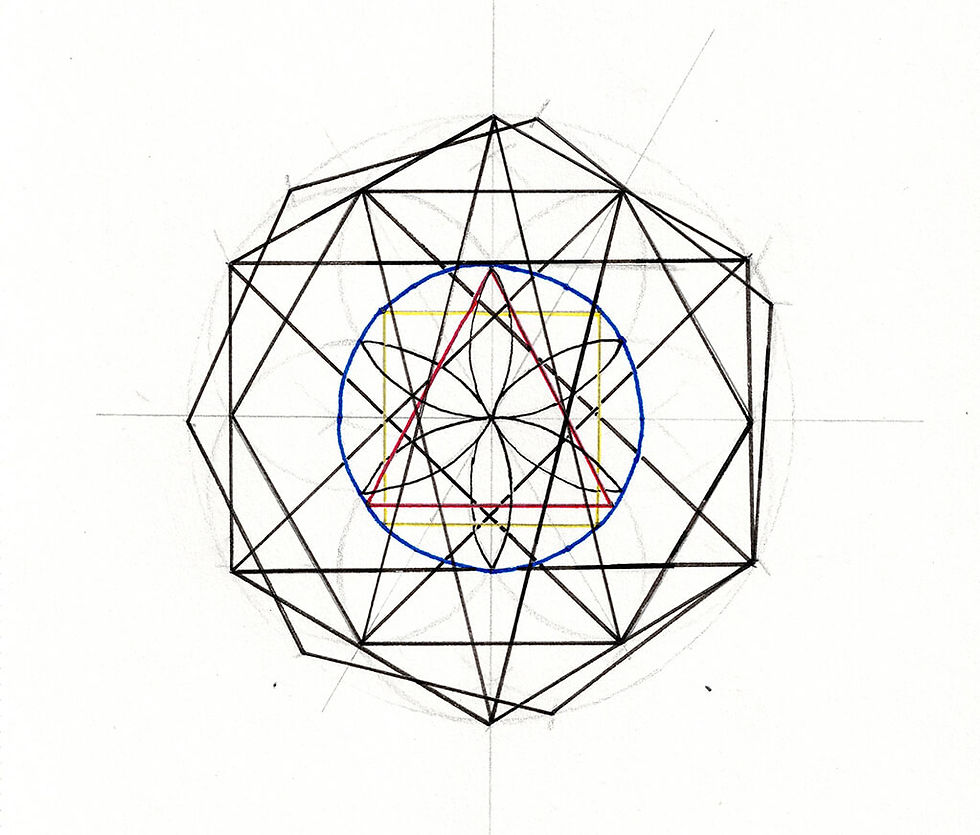
"Let none ignorant of geometry enter here" - Plato
Sacred geometry is often described as the language of the universe, a divine code that underlies all of creation. This intricate system of shapes, patterns, and mathematical principles reveals the hidden order of nature, bridging the realms of science, art, and spirituality. At its core, sacred geometry explores how geometric forms are not merely human inventions but fundamental aspects of the cosmos—thought forms of God, etched into the very fabric of existence.
The term "geometry" originates from the Greek words geo (earth) and metron (measure), initially referring to land measurement. However, for ancient philosophers like Pythagoras and Plato, geometry transcended practical applications. Pythagoras viewed numbers and geometric forms as sacred, believing that understanding them revealed cosmic truths. Plato expanded on this idea, introducing the concept of geometric forms as the pure, ideal thought forms behind material reality.
In classical education, sacred geometry was embedded within the Quadrivium—the four liberal arts of arithmetic, geometry, music, and astronomy. These disciplines were seen as interconnected pathways to divine understanding, with geometry serving as the key to unlocking the universe's hidden structures.
In Hindu cosmology, Brahma is the creator god within the Trimurti, alongside Vishnu (the preserver) and Shiva (the destroyer). Brahma represents the creative force that brings the universe into existence, embodying not just the act of creation but the very space in which creation unfolds. This concept of space (ākāśa in Sanskrit) is both the literal expanse and the metaphysical field that holds all forms, structures, and consciousness.
Brahma is often depicted with four faces, symbolizing the four cardinal directions and the all-encompassing nature of cosmic awareness. His presence signifies the boundless, infinite expanse where creation emerges and dissolves. In this sense, Brahma doesn’t just create within space—he is space, the canvas upon which the divine geometry of existence is drawn.
This aligns with Vedic philosophy where ākāśa is considered the first element, the substratum from which all other elements arise. It is the field in which vibrations, forms, and consciousness interact. Brahma, as the embodiment of ākāśa, represents the unmanifest potential that takes shape through sacred geometry.
At its most basic, sacred geometry begins with the point—a symbol of unity, origin, and the infinite potential of creation. A point has no dimension, representing pure existence without form.
When a point moves, it creates a line, introducing the first dimension. The line symbolizes connection, direction, and duality—linking the unmanifest to the manifest.
Extending the line in different directions forms a plane, the second dimension. Here, shapes like circles, triangles, and squares emerge, each holding profound symbolic meaning.
Sacred Shapes and Their Three-Dimensional Counterparts
Circle: The circle is the symbol of unity, wholeness, and infinity. It has no beginning or end, representing the eternal nature of the divine. When spun into three dimensions, it becomes the sphere, embodying completeness and the totality of the universe.
Triangle: The triangle represents balance, harmony, and the trinity found in many spiritual traditions (e.g., mind-body-spirit, birth-life-death). Its 3D form is the tetrahedron, a stable structure that symbolizes fire, transformation, and dynamic balance.
Square: Symbolizing stability, order, and the material world, the square forms the foundation of earthly existence. In three dimensions, it becomes the cube, representing structure, groundedness, and the four cardinal directions.
Platonic Solids: The Building Blocks of the CosmosPlato identified five perfect geometric forms, now known as the Platonic solids:
Tetrahedron (4 faces) – Fire
Cube (6 faces) – Earth
Octahedron (8 faces) – Air
Dodecahedron (12 faces) – Ether/Universe
Icosahedron (20 faces) – Water
Each solid has identical faces, edges, and angles, symbolizing the fundamental elements of existence. Plato believed these forms were the geometric essence of all matter, reflecting the divine architecture of the cosmos.
The Golden Ratio (phi ≈ 1.618) is a mathematical constant found in art, architecture, and nature. It represents perfect harmony and proportion, seen in everything from the spirals of galaxies to the growth patterns of plants.
The Fibonacci sequence (0, 1, 1, 2, 3, 5, 8, 13...) and the Lucas numbers (2, 1, 3, 4, 7, 11, 18...) are closely related to phi. These sequences describe natural growth processes, such as the arrangement of leaves, the pattern of sunflower seeds, and the spirals of shells.
Sacred geometry manifests throughout the natural world in the following ways:
Spiral galaxies mirror the Fibonacci sequence.
Honeycombs exhibit perfect hexagons for efficient space usage.
Snowflakes reveal intricate sixfold symmetry.
Flower petals and seed heads grow in spiral patterns reflecting phi.
These patterns suggest that nature follows geometric principles, as if the universe itself is a grand design woven with sacred mathematics.
Major Symbols and Their Interconnections
Vesica Piscis: Formed by overlapping two circles, it symbolizes the intersection of the divine and material worlds. It represents creation, balance, and the birth of duality from unity.
Seed of Life: A pattern of seven interlocking circles, symbolizing the seven days of creation and the genesis of all forms. It’s the foundation of more complex structures like the Flower of Life.
Metatron’s Cube: Derived from the Flower of Life, it contains all five Platonic solids, symbolizing the blueprint of creation and the interconnection of the elements.
Merkabah: A star tetrahedron, representing the balance of opposites—spirit and body, male and female, light and dark. It’s often seen as a vehicle for spiritual ascension.
Hexagons and Equilateral Triangles: Found in beehives, crystals, and molecular structures, these shapes symbolize harmony, efficiency, and the interconnectedness of all things.
Sacred geometry reveals the underlying order of the universe, a divine code etched into the very fabric of reality. Through simple forms like points, lines, and shapes, we glimpse the profound intelligence guiding creation. Whether in the spirals of galaxies, the symmetry of snowflakes, or the patterns within our own bodies, sacred geometry connects us to the infinite—reminding us that we are both the created and the creators within this cosmic dance. By studying these timeless patterns, we not only understand the universe but also our place within it, as reflections of the divine geometry that shapes all existence. In our next article on the Quadrivium, we will be exploring music as a form of mathematics.


Comments